
We have been writing about Canada’s structural deterioration since November 2025. The recession is confirmed. The CUSMA clock is running. The compounding risks are converging on the same moment. This is what we said was coming and what happens next.
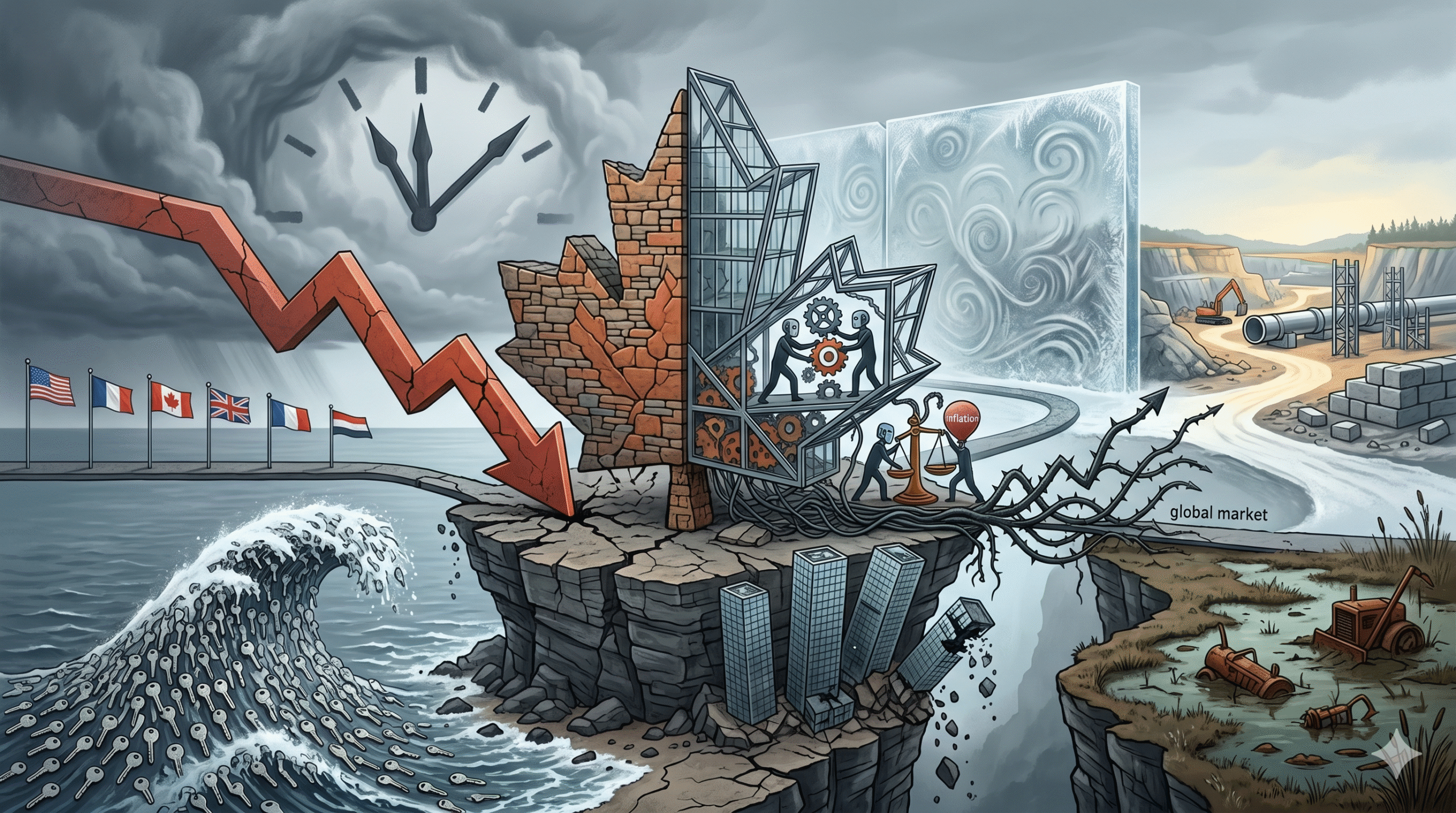
On May 29, 2026, Statistics Canada confirmed what we argued was inevitable in our November 2025 note “Canada: The New Japan in the Carry Trade.” Canada’s economy contracted for the second consecutive quarter. It is the only G7 economy in a technical recession. The bill was always going to come due. It has.
The financial press will tell you this is trade-induced and probably transitory. That reading is convenient and incomplete. Every other G7 economy absorbed the same tariff shock and kept growing. Canada contracted because it was structurally weakened before a single tariff was levied. The shock found the cracks. We showed you the cracks six months ago.
What is new is the convergence. CUSMA review deadline: July 1st. Mortgage renewal wave: peak mid-year. Urban condo completion wave: Q3. Bank of Canada: on hold with inflation risk preventing cuts. Global bond yields: rising into a fiscal expansion Ottawa cannot slow. AI displacement of entry-level workers: accelerating. Anti-immigration sentiment: highest on record. None of these is individually fatal. Together, arriving simultaneously, they are the full ledger. And it is all due at once.
The G7 Scorecard
Canada is alone. Every peer absorbed the tariff shock without contracting. The per-capita numbers tell the longer story: per-person GDP fell from 98% of the G7 average in 2014 to 92% by 2024, below the OECD average for the first time. Against the US, Canadian real per-capita GDP dropped from 76% to 68% over the same decade. Canada’s productivity gain since 1981: 61%. The United States: 127%. None of that is a tariff statistic.
| COUNTRY | Q2 2025 | Q3 2025 | Q4 2025 | Q1 2026 | STATUS |
| United States | +0.9% | — | — | +0.5% | Growing |
| United Kingdom | +0.3% | +0.1% | +0.1% | +0.6% | Growing |
| Germany | −0.2% | 0.0% | +0.3% | +0.3% | Recovering |
| France | +0.3% | +0.5% | +0.2% | 0.0% | Flat |
| Italy | −0.1% | 0.0% | +0.3% | — | Recovering |
| Japan | +0.5% | −0.7% | +0.1% | — | Volatile |
| Canada | −0.4% | +0.1% | −0.1% | −0.1% | Recession |
The Disease, Not the Trigger
Our November 2025 thesis was that Canada had entered a Japan-style cycle: real GDP per capita falling five consecutive quarters, productivity flat, business investment near a 20-year low, interest payments crossing $60B annually, a $78B deficit budget that prioritized spending over reform. Canada had the resource endowment Japan lacked; third-largest proven oil reserves, fourth-largest producer, sitting adjacent to energy-hungry Asian markets actively seeking supply alternatives. The lever existed. It was being refused.
The loonie drifts toward its function as a global carry-trade funding currency; useful for international borrowers, corrosive for domestic purchasing power and living standards.
Six months later the lever is still largely unpulled. Four pipelines cancelled, killed, or abandoned between 2016 and 2021. A fifth required a $4.5B federal Crown purchase before private capital would touch it. The May 2026 Implementation Agreement targets a 2027 construction start and 2033–34 first oil. Carney engages Alberta more constructively than his predecessor. That clears a low bar. The regulatory framework that produced the timeline above is intact, and the framework is the problem.
Where the Next Leg Down Originates
Real estate: the second wave
Toronto aggregate prices fell 4.7% year over year in Q1 2026. The median detached home in the city fell 9.7%. Vancouver fell 4.5%. The GTA is carrying close to two years of condo inventory, with actual housing starts running approximately 50% below official CMHC figures. The renewal wave compounds it: 1.15 million mortgages renew in 2026, another 940,000 in 2027, many originated near 2%. Five-year fixed holders face 20% payment increases. Variable-rate holders face up to 40%. This is not a national story. It is a Toronto and Vancouver story arriving into a recession, and it is not close to over.
AI and the entry-level labour market
Youth unemployment reached 13.8% in 2025; more than double the national average, and hit 18% in August, the highest since the pandemic. Canada lost 84,000 jobs in February 2026 alone. The Conference Board of Canada classifies 57.4% of Canadian jobs as highly exposed to AI. Workers aged 22–25 in AI-exposed occupations have already experienced a 13% relative employment decline since 2022. The structural shift is architectural: generative AI is compressing the corporate pyramid, eliminating the entry-level on-ramp that every senior professional passed through. Canada has no policy framework for this. The last meaningful federal labour standards update addressing technological change was 1973.
Immigration reversal and the politics of scarcity
Permanent resident targets have been cut from 500,000 per year to 365,000 by 2027. Anti-immigration sentiment has moved from 25% negative to 53% negative in a single year; the fastest deterioration in recorded Canadian polling on the subject. The investor-relevant consequence is not the protest movements. It is the demand destruction. The immigration reversal has hollowed out the tenant base for urban condos. AI displacement is suppressing household formation among the cohort that should be entering the rental and starter home market. Recession is delaying those decisions by two to three years. The demand Canada’s urban real estate priced in for a decade is not coming back on the expected timeline. The political reaction; further immigration restriction, extends the correction, which generates more political pressure. This is the loop.
CUSMA: The Mechanism That Determines Whether This Resolves or Compounds
The July 1 review is the hinge. CUSMA-compliant goods currently receive an exemption from Trump’s 35% fentanyl tariff, covering more than 90% of Canadian goods exports to the US. The Bank of Canada Governor has stated publicly that losing preferential access would push Canada into recession. Canada is already in recession. A bad outcome does not threaten a recession. It deepens one that all the forces above are already driving.
Four scenarios: clean 16-year extension (Bank of Canada base case, not guaranteed); significant renegotiation with higher trade costs (most likely non-base outcome); annual reviews creating a rolling negotiation environment that permanently depresses business investment; or US withdrawal, putting Canada facing 35% tariffs across most goods exports. Scotiabank’s macro model is unambiguous: any scenario short of a clean extension deepens the contraction.
Here is the inversion. The CUSMA pressure, if severe enough, may force what a decade of comfortable politics would not. Supply management, the carbon pricing architecture, the interprovincial trade barriers, the pipeline regulatory framework; all survive because the cost of reform has been politically visible and the cost of inaction has been diffuse. An economic tsunami changes that arithmetic. Canada’s most significant structural reforms; the 1988 FTA, the Chretien-Martin deficit elimination, both arrived under genuine external pressure, not comfortable political choice. We are not forecasting that outcome. We are identifying, for the first time in a decade, the conditions under which it becomes possible.
Six-Month Danger Zones
The risk is not a single shock. It is the simultaneous arrival of pressures that are individually manageable and collectively are not. Here is the specific exposure map.
| ZONE | RISK LEVEL | THE SPECIFIC EXPOSURE |
| Long CAD bonds | Critical | 10Y yield at 3.6%, BoC on hold at 2.25%, Ottawa running $502B budget. Rate-cut thesis is dead. Duration pain is not over. |
| GTA/Van condos | Critical | Q3 2026 completion wave: pre-sold 2021–22 units closing at prices above current market. Forced closings, distressed assignments, and developer losses concentrated July–October. |
| Unhedged CAD equity | Critical | CUSMA tail risk puts CAD at 68–70 cents in adverse scenario. Unhedged Canadian equity carries this currency loss uncompensated. |
| Consumer discretionary | Elevated | Ontario and BC households absorbing mortgage payment shock of 20–40%, job losses, and falling home equity simultaneously. Q2 rebound is resource-driven, not consumer-led. |
| Private credit / leveraged loans | Elevated | Refinancing environment materially worse than origination. Urban office, mid-market trade-exposed businesses, and immigration-dependent sectors marked at stale valuations. |
| Immigration-dependent businesses | Elevated | Universities, colleges, language schools, and adjacent retail facing structural enrollment cliff. $37B international student economy contracting sharply and not recovering on prior timeline. |
Where We Stand and What to Watch
The long thesis is unchanged. Canada is a resource platform with world-class assets, mispriced as a growth economy. Energy, mining, and critical minerals; particularly the sovereign buyer demand for antimony, tungsten, copper, and potash from Western-aligned capital mandated to source outside China, remain the primary investment case. Alberta is the hub. CAD-hedged or USD-linked revenue structures are preferred across all Canadian resource names. The loonie is structurally suppressed and that suppression deepens in any adverse CUSMA scenario.
Avoid domestic consumer discretionary, rate-sensitive duration, unhedged Canadian equity, and residential real estate in Toronto and Vancouver. The Q2 2026 oil and gas rebound is real and narrow. Do not read it as a broad recovery signal.
The two signals to watch: A CUSMA outcome by July 1 and a confirmed pipeline construction commencement before year-end 2026. If both happen, the structural reform thesis is live and the long Canada resource trade accelerates. If neither happens, the Japan stagnation trade extends; lower loonie, suppressed real rates, capital continuing to leave for jurisdictions with cleaner policy lines. Those are the two scenarios. The next six months will tell you which one you are in.
Conclusion
The bill comes due not because of Trump, not because of a tariff, and not because of a bad quarter. It comes due because a decade of structural choices accumulated into a system that could not absorb a moderate external shock without contracting. We wrote about that system in November. The recession is the system confirming the diagnosis.
The only genuinely bullish statement we can make about Canada’s near-term outlook is this: the pain may finally be severe enough to force the structural reform that comfortable politics refused to deliver. That depends on the CUSMA outcome, on whether Carney’s engagement with Alberta translates into product actually moving to market, and on whether the political cost of inaction finally exceeds the political cost of change. The next twelve months will answer it. Position for the chop in the meantime.
[1] Perspectives by Moneta, “Canada: The New Japan in the Carry Trade,” November 5, 2025.
[2] Statistics Canada, May 29, 2026. Q4 2025: −1.0% annualized. Q1 2026: −0.1% annualized.
[3] OECD Quarterly GDP releases, Q4 2025 and Q1 2026.
[4] Government of Alberta, Keystone XL. Direct cost: $1.3B. Foregone royalties: $30B over 20 years.
[5] Fraser Institute, January 2021. $20.6B foregone energy revenue figure is for 2018.
[6] Alberta/Canada West Coast Oil Pipeline Implementation Agreement, May 15, 2026.
[7] Bank of Canada, MPR January 28, 2026. CUSMA base case and risk scenarios.
[8] Scotiabank Global Economics, “Low Probability, High Cost: The Macroeconomics of Abandoning CUSMA,” March 5, 2026.
[9] Royal LePage Q1 2026. National −2.0% YoY; GTA −4.7%; Vancouver −4.5%. City of Toronto detached: −9.7%.
[10] CIBC Economics. GTA actual starts ~50% below official CMHC figures.
[11] CMHC / Desjardins. 1.15M renewals 2026, 940K in 2027. Fixed: ~20% payment increase; variable: up to 40%.
[12] Conference Board of Canada, 2024. 57.4% of Canadian jobs highly exposed to AI.
[13] Statistics Canada / TD Economics. Youth unemployment 13.8% annually, 18% peak August 2025.
[14] Abacus Data, March 2026. 53% of Canadians view immigration negatively; 44% support eliminating the TFWP.
[15] Trading Economics / Bank of Canada. Canada 10Y yield at 3.6% March 2026. BoC held at 2.25%.
About Moneta
Moneta is an investment banking firm that specializes in advising growth stage companies through transformational changes including major transactions such as mergers and acquisitions, private placements, public offerings, obtaining debt, structure optimization, and other capital markets and divestiture / liquidity events. Additionally, and on a selective basis, we support pre-cash-flow companies to fulfill their project finance needs.
We are proud to be a female-founded and led Canadian firm. Our head office is located in Vancouver, and we have presence in Calgary, Edmonton, and Toronto, as well as representation in Europe and the Middle East. Our partners bring decades of experience across a wide variety of sectors which enables us to deliver exceptional results for our clients in realizing their capital markets and strategic goals. Our partners are supported by a team of some of Canada’s most qualified associates, analysts, and admin personnel.