
How Software Companies Must Rebuild for Durability in the AI Era
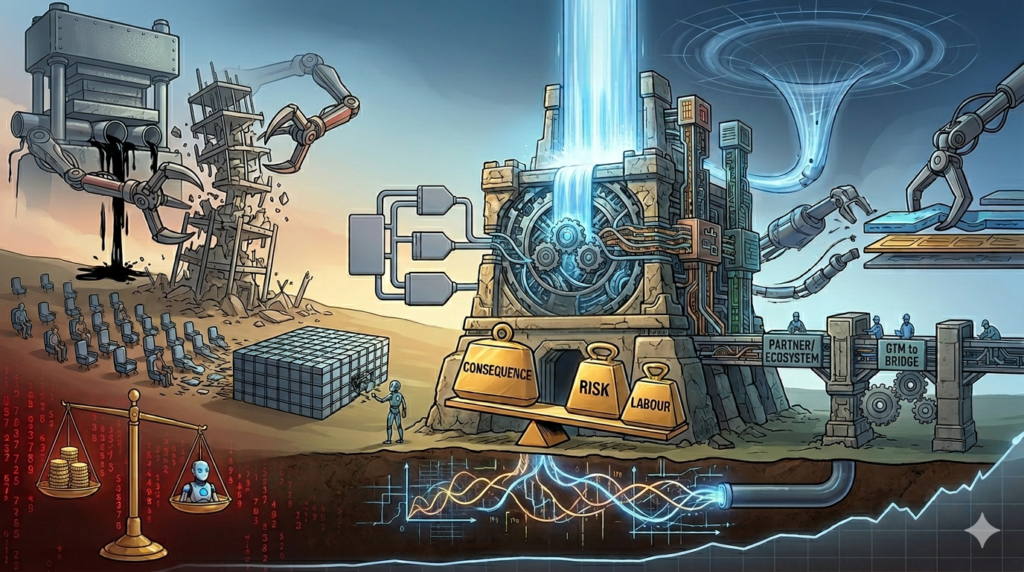
The Reckoning
What we described in earlier publications has now arrived with empirical force. When our last report was published, iShares Expanded Tech-Software ETF (IGV) was down 32% from its recent high while the Nasdaq held flat. That was the signal. What followed confirmed the thesis: a sector-specific repricing that has now erased approximately $2 trillion from software market capitalization since early 2026; the largest AI-driven selloff in history, and the first time software forward price-to-earnings multiples have fallen below the S&P 500 average since the cloud era began.
The most visible catalytic event was Anthropic’s release of Claude Cowork in January 2026. The product demonstrated, in production and at scale, that a single AI system could autonomously execute complex professional workflows spanning legal review, compliance automation, financial analysis, and document orchestration; functions that dozens of distinct SaaS products had been monetizing for years. The market reaction was immediate and severe: approximately $285 billion in software market value was erased within days of the launch, based on aggregate market cap data across the IGV constituent universe.[1] Median EV/Revenue multiples, which had hovered near 7x entering 2025, compressed to between 3.1x and 3.4x by March 2026. The correction was not isolated to names with direct product overlap. What analysts called the “SaaSpocalypse” was a structural repricing of the whole SaaS model and Cowork was the proof of concept the market had been waiting for.
Now, there are signs the capitulation phase may be ending. Institutional buyers are beginning to rotate back into beaten-down names. But the recovery is not uniform and that bifurcation is the point. The companies recovering are precisely those that made the transition our earlier report described. The companies still falling are those that did not.
The equation for investors and operators remains what it always was: this is both cyclical repricing and structural displacement, but not in equal measure. The cyclical component will resolve. The structural component will not. One data point captures why: 88% of enterprises have now deployed AI, but research across five major consultancies converges on a striking finding; only approximately 5.5% qualify as high performers generating meaningful EBIT impact. That 16-to-1 ratio is not a transition problem. It is a commercial opportunity for the software companies this report describes.
The Hyperscaler Advantage Is Structural, Not Cyclical
Hyperscalers are not winning because they have better models. They are winning because they own the scarcities AI cannot bypass. They control compute supply and pricing, data centre real estate and power access, capital at industrial scale, global distribution into enterprises, governments, and developers, and increasingly their own silicon, networking, and energy strategies.
This matters because AI does not scale like SaaS. It scales like heavy industry. Training, inference, orchestration, and agentic autonomy all require persistent access to power, chips, cooling, bandwidth, and regulatory permission. These inputs are capital-intensive, slow to expand, and politically constrained. Hyperscalers can amortize them. Most SaaS companies cannot.
As a result, hyperscalers can subsidize AI indefinitely, compress margins downstream, bundle AI into products customers already pay for, and treat AI as infrastructure rather than a profit centre. Any SaaS company whose value proposition depends on accessing intelligence rather than owning consequence is now downstream of a player that can replicate, bundle, or undercut it at will.
The cloud era analogy; that hyperscalers would displace the application layer, was never realized, and enormous value was created by companies building on top of hyperscaler infrastructure. But the analogy has limits. The companies that survived and compounded in the cloud era did so by owning workflows, not just providing access to them. The same principle applies here, under stricter conditions. One material difference: regulatory bodies in the US and EU are scrutinising what they call “AI toll booths”; the concern that infrastructure incumbents will use compute and distribution control to extract rents from the application layer. The practical implication for SaaS operators is narrow but real: antitrust scrutiny may slow the pace of hyperscaler bundling in regulated verticals, preserving commercial room for application-layer companies in financial services, healthcare, and government technology that have embedded compliance functions hyperscalers are unwilling to own. This does not change the structural direction of travel. It changes the timeline available to application-layer companies in those verticals and that window is still closing.
The Great SaaS Unbundling
The AI transition is not eliminating software. It is re-sorting it. In the SaaS era, value accrued to UX, workflow aggregation, seat expansion, and feature velocity. In the AI era, value accrues to control over outcomes, ownership of risk, embedded memory and context, and replacement of labour rather than augmentation of it.
The bear case for software is, at its core, a commoditisation argument: if creating code is incredibly cheap, anyone can replicate existing software products, including customers themselves. Agentic AI sharpens this. We do not dismiss the argument. But we believe the commodification of code is being over-extrapolated as a category-destroying shift. The hard parts of building software; identifying the right problem, designing the right solution, building a go-to-market, earning the trust required to deploy inside a complex enterprise, still exist in a world of abundantly cheap code.
The companies that will fail are not those who face AI. It is those who face it without workflow ownership, without contextual depth, and without a credible claim to consequence.
The “seat compression” thesis has moved from analytical framework to budget line item. A February 2026 SaaStr analysis was direct: the question for enterprise IT is no longer whether they will spend on software, but whether they will spend on your software or redirect that budget to AI. Corporate AI spend is doubling from 0.8% to 1.7% of revenues in 2026 alone. Every dollar flowing to AI infrastructure is a dollar not going to another Salesforce seat, another Workday module, another ServiceNow add-on.
The arithmetic is stark. IBM research shows that in service-oriented enterprises, labour represents approximately 60% or more of operational costs, while enterprise software represents roughly 5%. Every prior enterprise technology wave; client-server, the web, cloud, SaaS, sold into that 5% software slice. AI agents are the first wave to sell into the 60% labour slice. The TAM implications are structurally different, and the winners will be those who position on the right side of that equation.
Categories Most Exposed
1. Horizontal Productivity Tools
Anything that improves individual efficiency, sits above workflows rather than inside them, and competes on UI, templates, or convenience. Generic project tools, note-taking platforms, lightweight analytics dashboards, and broad productivity copilots fall here. These are precisely the layers hyperscalers can absorb into operating systems, cloud suites, or browsers. Their moats are narrowing.
2. Thin AI Wrappers
Application-layer products whose core differentiation is prompt engineering, API access to foundation models, or cosmetic verticalization. These tools face collapsing switching costs, margin compression from model pricing, and feature parity from platforms that control the underlying inference economics. The question capital now asks; does this AI replace something expensive, or does it merely produce useful answers, is fatal for most of this category.
3. Optional Analytics and Insight Tools
SaaS products that surface insights without acting on them, require humans to operationalise outputs, and do not own the downstream decision. In a world of agentic systems, insight without execution is increasingly a feature, not a product. The data moat has narrowed: data gravity is necessary but no longer sufficient.
4. Tools Priced Per Seat in Automatable Roles
Any SaaS that monetises knowledge work AI can replace, junior or repetitive labour, or manual review and coordination layers. When AI agents can do the work of five mid-level employees, the per-seat subscription model; the bedrock of the SaaS industry for two decades, loses its foundation. IDC’s 2026 FutureScape report projects that by 2028, pure seat-based pricing will be obsolete, with 70% of software vendors having refactored their pricing strategies around new value metrics.
| Companies Repricing Down | Companies Recovering / Resilient |
| Atlassian (TEAM): -35% | Palantir (PLTR): resilient throughout |
| Workday (WDAY): -40% | ServiceNow (NOW): recovering on Agentic ACV |
| Adobe (ADBE): -36% (creative workflow AI substitution) | Salesforce (CRM): recovering on Agentforce |
| Intuit (INTU): -46% (AI-native tax/fintech displacement) | Microsoft (MSFT): essential anchor of recovery |
Select stock performance from 2025 peak to April 2026. Figures illustrative based on reported market data. Not investment advice.
What Survives: Four Categories with a Path
The market is not destroying software as an asset class. It is sorting it. The companies that have already made the transition are recovering. Those that have not are still falling. The categories with durable paths share a common structure: they own something hyperscalers rationally avoid, accumulate something AI cannot instantly replicate, and sit between the enterprise and a risk the enterprise cannot self-insure.
1. Mission-Critical Systems of Record
Platforms embedded so deeply in enterprise operations that removal requires a replacement project measured in years, not months. Two distinct moat structures belong here, and it matters to distinguish them. The first is regulatory and compliance depth: accumulated certifications, audit histories, and jurisdiction-specific expertise impose lengthy qualification cycles on new entrants. These moats compound with deployment scale and widen as regulatory environments grow more complex; hyperscalers do not want to carry the reputational and liability exposure of encoding jurisdiction-specific rules.
The second is stateful memory: systems that learn idiosyncratic workflows over time, accumulate institutional exception-handling, and encode tacit organisational knowledge that does not transfer with a data export. Statefulness creates switching costs that do not appear on a feature comparison chart. Hyperscalers optimise for stateless scale. Application-layer winners optimise for stateful entrenchment. Both moat types compound; neither is easily replicated by a model with access to the same underlying compute.
2. Full-Cycle Process Replacement
Platforms that replace BPO contracts, consultants, or internal teams, execute end-to-end workflows autonomously, and are measured on outcomes rather than usage. These companies stop behaving like software vendors and start behaving like synthetic operators. Capital understands this model because it resembles infrastructure economics: slower growth curves, but stronger entrenchment.
The model shift is already underway. Hybrid structures combining a base platform commitment with consumption-based and outcome-based components have become the norm for AI-native services. The companies that lock in outcome-linked economics before the market standardises will accumulate structural advantages that compound. A February 2026 Goldman Sachs survey found that 49% of institutional allocators planned to increase software exposure; the highest net figure since 2017, concentrated in companies demonstrating this model.
3. Vertical Systems with Embedded Liability
Where domain specificity is a moat, not a bug. Hyperscalers will not encode jurisdiction-specific regulatory nuance, industry-specific heuristics, or profession-level accountability. They do not want to manage regulatory nuance across jurisdictions, maintain vertical-specific edge cases, or carry reputational risk for specialised failures. SaaS companies that do can trade TAM for inevitability.
Gartner’s vertical SaaS M&A forecast for 2026 projects that 30% of SaaS M&A deals will involve vertical software; reflecting how much capital has concluded that domain depth, not horizontal breadth, is where durable value now lives.
4. Companies with Proprietary Data and Contextual Depth
Companies that only provided a better interface to access publicly available data face serious threats. But raw data ownership is a weaker moat than it was. The competition has shifted from data control to actionable context – from having data to understanding how it translates to business value through knowledge representation, enrichment, contextual reasoning, and learning systems. Companies that build context graphs and learning systems on top of their data gravity earn durable advantages. Those that merely sit on historical data do not.
What the Transition Looks Like in Practice
The theoretical case for the transition has been validated by the companies executing it. The market data makes clear what is working and what is not.
Salesforce is the most instructive example of an incumbent making the transition at scale. Agentforce ARR reached $800 million by end of fiscal 2026, up 169% year-over-year, with 29,000 deals closed. The company introduced “Agentforce Work Units”; a new billing metric tracking task execution by AI agents rather than human logins. Management’s framing was explicit: the company has rebuilt itself as “the operating system for the Agentic Enterprise.” The stock is recovering. The companies that did not make an analogous pivot are not.
ServiceNow introduced “Agenttic ACV” – annual contract value tied to tasks completed by AI agents rather than human credentials. That shift has allowed it to recover nearly half of its Q1 2026 losses, as investors reward the ability to monetise AI productivity rather than headcount. The company’s positioning as an “AI control tower” for enterprise workflows is a direct expression of the sovereign-system thesis: deeply embedded, outcome-accountable, irreplaceable.
Palantir has been the single most resilient large-cap software company through the entire correction. Its foundational operating system approach; deeply embedded in enterprise and government workflows, carrying explicit outcome accountability, accumulating institutional memory over years of deployment, is exactly the profile this report describes. FY2025 TCV reached $10.8 billion, up 128% year-over-year. A Forrester Total Economic Impact study found 315% ROI and $262 million NPV at composite enterprise scale.
What Transitioning SaaS Companies Must Actually Do
A “pivot to AI” is meaningless. A credible transition requires structural change across product, business model, and organisational posture simultaneously. The reason this moment is so challenging is that progress is required on multiple dimensions at once. Companies that have not yet seen significant acceleration in their AI-native products and substantial efficiency gains materially impacting profitability have likely not yet begun the transition in any meaningful sense. The bar is also rising: the large incumbents that have executed this transition publicly are now competitors for the positioning, not just benchmarks.
1. Move From Tools to Ownership
The defining question capital now asks is simple: who owns the downside if this system fails? If the answer is the customer, the product is optional. If the answer is the vendor, the product begins to resemble infrastructure. Surviving SaaS companies take responsibility for outcomes, sit contractually between the enterprise and the risk, and are paid for resolution rather than activity. This is not a marketing framing. It is a structural commitment that changes how the company is organised, how contracts are written, and what success looks like.
2. Replace Labour, Quietly
The real AI ROI is not productivity – it is labour substitution. The strongest companies eliminate outsourced spend, compress organisational layers, and absorb politically difficult change on behalf of customers. They do not market this aggressively. They demonstrate it economically. Labour represents approximately 60% of operational costs in service-oriented enterprises; enterprise software represents roughly 5%. A labour-substitution engagement sizes at three to five times the value of a software-resale engagement at the same customer. That arithmetic is why BCG’s highest-performing CEOs are directing more than half of their 2026 AI investment to agents specifically.
3. Abandon Seat-Based Economics
Per-seat pricing assumes stable headcount and human-centred workflows. Both assumptions are breaking. Durable AI-centric entities move toward outcome-based pricing, share-of-savings models, and SLA-driven contracts. This aligns vendor incentives with customer survival; a fundamentally different commercial relationship than the SaaS era created.
The market data on pricing velocity is striking: analysis of the top 500 SaaS and AI companies recorded more than 1,800 pricing changes in 2025 alone; an average of 3.6 per company per year. Any contract assuming stable unit prices over 36 months is modelling a world that no longer exists. AlixPartners projects that hybrid SaaS pricing models featuring usage- and outcome-based elements will comprise up to 40% of software revenue by the end of 2026.
The pricing ceiling has also changed. Research from Tomasz Tunguz and others documents that agent prices can reach 75–95% of the fully-loaded FTE equivalent in labour-short markets – because software substituting for human labour is measured against a labour-cost reference frame, not a software-licensing reference frame. This raises the commercial opportunity for companies that make the transition, and it changes the ceiling for what outcome-based contracts can be worth.
4. Build Memory as a Product Feature
AI without memory is a demo. AI with memory becomes embedded. Systems must retain context across time, learn from feedback, and improve autonomously inside a specific environment. Deployment friction is no longer a red flag – it is often a moat. Products that require deep integration to deploy are products that are expensive to remove. The distinction matters in practice: a generic LLM API call retrieves intelligence from a shared model trained on public data. A system like Palantir’s AIP compounds continuously against a specific customer’s proprietary data, operational history, and decision logic – building contextual depth that cannot be replicated by switching providers. The switching cost is not the contract; it is the accumulated institutional memory. Companies that build memory as a core architectural commitment, not a product feature, are building the same compounding advantage.
5. Build Defensibility in the GTM Architecture
Both the business model of software and the way it is sold are changing rapidly. The enterprise sales quality, scale, and global reach that distinguished the SaaS era remain important. But forward-deployed engineering capability that drives adoption and retention is becoming critical. Companies best positioned are those that have built ecosystem depth; breadth of developer, partner, channel, and platform integrations that embed the product into adjacent workflows and buying decisions.
6. Accept a Smaller, Harder Market
The SaaS era rewarded breadth. The AI era rewards depth under constraint. Companies must accept narrower markets, longer sales cycles, and higher responsibility. In exchange, they gain durability. The companies that tap budgets; services spend, labour replacement, outcome-based contracts, that were never accessible to traditional SaaS will find themselves in markets that are harder to enter and harder to exit.
The Consolidation Wave
What we predicted as an eventual consolidation of mid-market SaaS is now underway. AlixPartners projects M&A deal volume in the software industry will surge 30–40% year-over-year in 2026, with deal value potentially reaching $600 billion. 2025 was already a record year for SaaS M&A, including Google’s $32 billion acquisition of Wiz; the largest pure-play SaaS acquisition in history, and ServiceNow’s $2.85 billion acquisition of Moveworks.
The bifurcation in M&A pricing is as stark as the bifurcation in public market performance. AI-native companies with outcome-based metrics are commanding 5-6x valuation premiums over SaaS peers and achieving 7-8 percentage points higher growth. Distressed SaaS companies most exposed to AI substitution; customer support automation, content creation, simple CRM, are becoming acquisition targets at discounted multiples. Private equity firms are preparing multi-billion dollar take-private bids for mid-cap names that have seen their stocks halved despite remaining cash-flow positive.
The consolidation is not random. Buyers are targeting companies with four characteristics: proprietary data embedded in defensible product architectures, mission-critical workflow positions difficult to displace, genuine AI integration rather than feature-level AI addition, and strong net revenue retention, now the primary growth lever in a market where new customer acquisition costs rose 14% through 2025.
For operators, the message is clear: the window to execute a credible transition before becoming an acquisition target at a distressed multiple is narrowing. Private equity acquirers are not buying to transform. They are buying to harvest.
The Adoption-Value Gap Is the Market Opportunity
There is an uncomfortable but important corollary to the structural disruption thesis: the companies positioned to exploit it are extraordinarily well-placed. Research across McKinsey (n=1,993), Deloitte (n=3,235), BCG, IBM, and PwC converges on a striking finding: 88% of enterprises have deployed AI, but only approximately 5.5% qualify as high performers; defined as reporting more than 5% of EBIT attributable to AI and significant measurable value. That is a 16-to-1 ratio.
PwC’s decomposition explains why the gap is structural: approximately 20% of an AI initiative’s value comes from the technology itself; approximately 80% comes from workflow redesign, process reengineering, organisational change, data preparation, and governance. Enterprises that deploy technology without the surrounding work are structurally capped at roughly 20% of available value.
IBM finds that companies excelling across three adoption dimensions; AI-first operating model, leadership accountability and talent, and governance, are 32 times more likely to achieve top-tier business performance. The gap between the high performers and the broad base is not narrowing; it is widening, because the organisations that invested in data infrastructure two to three years ago are compounding advantages their peers cannot quickly replicate.
For software companies making the transition this report describes, the implication is commercial, not just strategic. The 80% of AI value that enterprises are not yet capturing is not a software SKU; it is workflow redesign, change management, governance implementation, and contextual depth. These are precisely the things that deeply embedded, outcome-accountable, stateful software systems are positioned to deliver.
The End State: SaaS Becomes Synthetic Infrastructure
The SaaS companies that survive this transition will not look like SaaS companies. They will resemble quiet operators, embedded systems of record, AI-driven service replacements, and infrastructure-adjacent platforms. They will grow more slowly but unwind with difficulty. They will trade narrative for inevitability.
The application layer is not being erased. It is hardening. The global software market will grow significantly across this transition, as it has across every prior platform shift. Buyers will continue paying for services that make them better at their own core function. The companies that execute against the imperatives in this report will survive the current repricing and take greater share of an expanded market.
The central tension is time. Incumbents with strong moats have real advantages, but those advantages are depreciating assets if the operating model does not evolve in parallel. AI-native companies have execution velocity, but many have yet to prove they can build the commercial infrastructure required to serve enterprise buyers at scale. Neither position is fully secure.
The signals worth watching: measurable AI-native revenue contribution as a percentage of total revenue; margin expansion as companies optimise AI infrastructure; changes in net dollar retention that reflect whether AI products are expanding or cannibalising existing spend; headcount-to-revenue ratios indicating whether efficiency gains are real; and the pace at which companies ship new capabilities relative to frontier model releases.
Final Thought
The great mistake many SaaS founders make is assuming that intelligence alone still creates defensibility. It does not. In an era where hyperscalers control compute, energy, capital, and distribution, the only durable software is software that owns consequence, replaces cost, accumulates memory, accepts liability, and operates where scale is undesirable.
What is dying is the assumption that digitising a workflow and charging per-seat for access will continue to be a durable business. That model delivered enormous value for two decades. The bar is now rising faster than at any point in the industry’s history. Companies that clear it will tap budgets that were never accessible to traditional SaaS. Companies that do not will find themselves competing on price in a market where the cost of producing code is approaching zero.
SaaS is not dead. But the era of lightweight software is. The correction of 2026 has made that visible. The companies recovering are the proof. The companies still falling are the warning.
[1] Aggregate market capitalisation loss across iShares Expanded Tech-Software ETF (IGV) constituents, based on reported closing prices. Single-session attribution reflects the largest daily drawdown in the sell-off window; total figure accumulates across the five trading days following the January 2026 product release. Moneta Securities internal analysis using publicly available market data.
About Moneta
Moneta is an investment banking firm that specializes in advising growth stage companies through transformational changes including major transactions such as mergers and acquisitions, private placements, public offerings, obtaining debt, structure optimization, and other capital markets and divestiture / liquidity events. Additionally, and on a selective basis, we support pre-cash-flow companies to fulfill their project finance needs.
We are proud to be a female-founded and led Canadian firm. Our head office is located in Vancouver, and we have presence in Calgary, Edmonton, and Toronto, as well as representation in Europe and the Middle East. Our partners bring decades of experience across a wide variety of sectors which enables us to deliver exceptional results for our clients in realizing their capital markets and strategic goals. Our partners are supported by a team of some of Canada’s most qualified associates, analysts, and admin personnel.